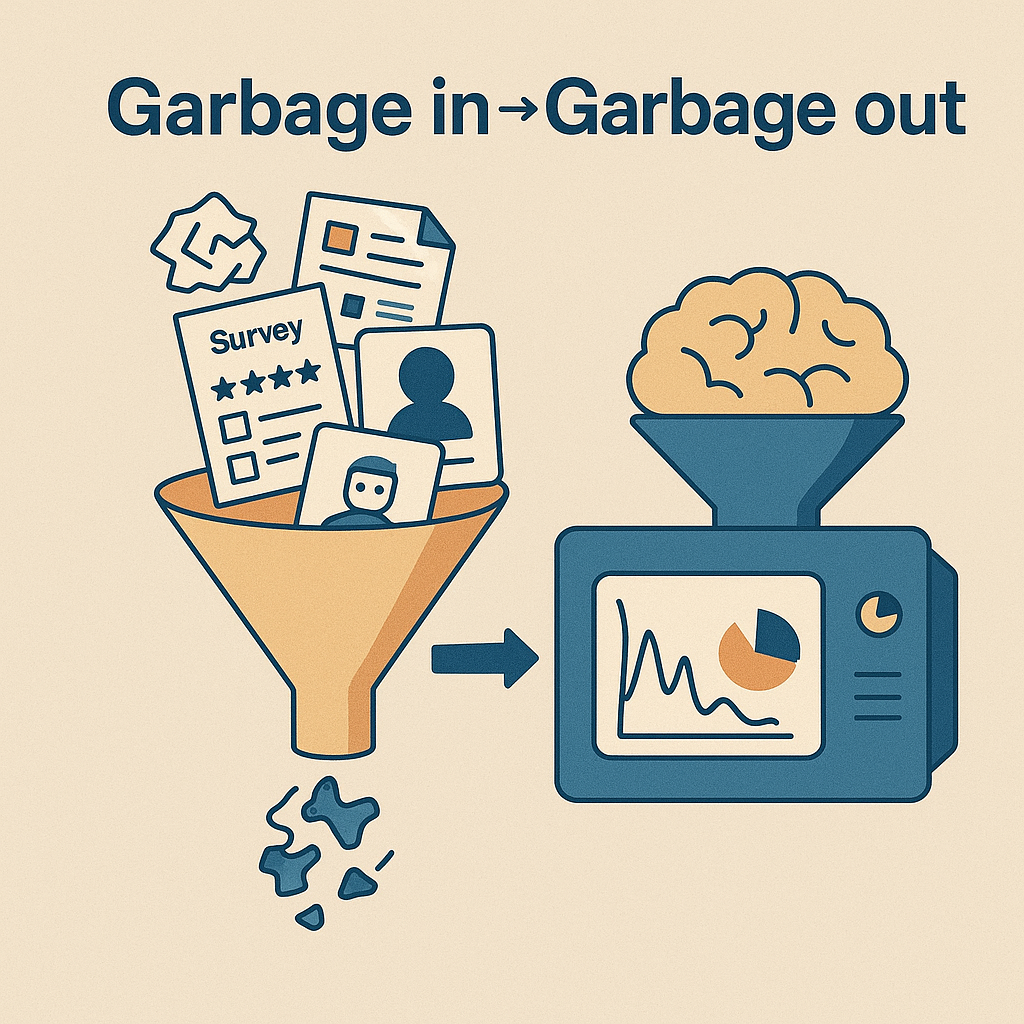
Garbage In, Garbage Out: Why Your ROI Lives or Dies on the Research Question
If you have ever stared at a dashboard thinking the numbers feel oddly hollow, the problem probably began long before fieldwork. In research, the quality of the answer rarely exceeds the quality of the question. “Garbage in, garbage out” is not a cynical slogan. It is a rule of physics for insight. A vague or loaded research question can waste budget, slow teams and nudge a business toward confident but wrong decisions.
Let’s be honest about how bad questions creep in. They sound sensible in a meeting. “Do customers like our product?” “Would you recommend us?” “How excited are you to upgrade?” Each line hides assumptions. Like compared with what. Recommend to whom. Excited at what price. The result is feedback that reads well and changes nothing. You can ship a project, tick the research box and still have no idea what to do next Monday.
We have all seen the cost of this. Amazon’s Fire Phone is a classic example. It was packed with novel features that impressed reviewers, yet consumers did not budge from ecosystems that already worked for them. The research question should have been sharper: which trade off of features and app availability wins preference at realistic prices. A robust study using carefully framed questions would have tested the value of novelty against the penalty of a thin app store. Instead, inventory gathered dust and a clever idea turned into a very public lesson.
Netflix’s short lived Qwikster split tells a similar story from a different angle. The decision bundled a price change with a naming and migration change. If the research question had asked “how will customers explain this to themselves and what friction will they feel during the switch,” the team would have measured comprehension and hassle, not just willingness to pay. Hundreds of thousands of subscribers churned in a single quarter. That is an expensive way to learn the difference between what a company announces and what customers understand.
Then there is New Coke. Thousands of taste tests said people preferred the sweeter formula. The research question was about taste. The decision was about identity. It was never only “is this nicer in a blind sip.” It was “should we replace a cultural icon or extend it.” When you measure the wrong construct, you can be right on your numbers and wrong in the world.
So how do you stop value leaking out of your questions. Start with the decision, not the dataset. Write the slide you hope to present to your board. “We should keep the classic brand and launch a sweeter line extension at price X because it grows preference by Y and protects loyalty among group Z.” Now reverse engineer. What do you need to know to defend that sentence. Which constructs matter. Preference share, willingness to pay, switching risk and attachment. Those words become the spine of your questionnaire.
The second habit is to make every abstract term concrete. Trust becomes “would you link your bank account for one tap checkout.” Value becomes “which bundle would you choose at this price.” Delight becomes “what surprised you positively in the first five minutes of use.” You can improve moments. You cannot directly improve a vague concept. When the question is concrete, a product manager knows what to change and a finance lead knows how to model the impact.
Third, design questions to falsify your favourite theory. If you believe a new plan name will increase upgrades, write the item that could prove you wrong. Show realistic plan cards, ask people to choose and measure upgrade intent and churn risk. If the uplift does not appear, you have saved marketing a lot of time and your customers a lot of confusion. This is not about negativity. It is about learning at low cost.
Language matters more than we like to admit. Jargon that feels natural inside a company sounds alien everywhere else. Leading wording makes people politely agree with your plan. Compound items such as “How satisfied are you with the speed and reliability of our app” mix two constructs that often trade off. If a respondent scores you low, do you optimise speed or reliability. Split it. Ask one thing at a time. Plain words beat clever ones. Short questions beat long ones. Your respondents are not trying to catch you out. They are trying to help you make a decision. Meet them halfway.
There is also the discipline of timing. Ask too early and people will guess. Ask too late and they will have adapted to the status quo. The sweet spot sits just before you commit budget to an irreversible path. Pilot quickly. Fix the rough edges. Then field with a clean, respectful survey that only asks what you will act on. If you would not change a decision based on an answer, do not ask the question.
A favourite trick for keeping surveys honest is to write a mini analysis plan before you draft items. Sketch the two or three charts you want to show. Perhaps a simple share of preference bar chart by segment, a willingness to pay curve and the distribution of time to first success in a new flow. Then ask yourself whether your questions can produce those charts. If not, rewrite them. This takes an hour and regularly saves weeks.
Real world packaging offers a neat reminder of how specific questions protect value. Tropicana’s 2009 redesign looked clean and modern on a designer’s desk, yet sales fell hard because shoppers could no longer find the carton quickly on a crowded shelf. A research question asking “how fast can typical shoppers find and recognise our pack among competitors” would have led to a simple shelf test before rollout. Beauty is fine. Findability pays the bills.
One final point. Good questions do more than collect data. They act as a social signal inside a company. When you ask for the minimum needed to decide, you teach teams to respect customers’ time. When you avoid loaded language, you tell colleagues you are here to learn, not to prove a point. Those signals compound into a culture that wastes less and builds better.
How ANI quietly helps you ask the right questions
ANI Research was built for this exact problem. The pet name is A needed innovation and it doubles as a promise. The platform guides you from business challenge to survey design, analysis and clear results without turning research into a marathon. You start by choosing a path that matches your decision. Market Exploration if you are scanning a category and looking for opportunities. Product or Brand Analysis if you are refining features, perception and experience. A or B Testing if you need to compare ads, pricing, packaging or concepts before you invest.
You then share your context in a short conversation with ANI, your AI research advisor. It behaves like a diligent consultant who keeps asking “what decision are we trying to make.” Based on that, ANI proposes a set of targeted questions and lets you refine the wording in chat. The system keeps the core survey to a maximum of ten research questions so focus does not drift and respondents are treated with respect.
When you are ready, you can run with your own audience or tap into a trusted global panel that spans more than 140 countries. Before anything launches, PhD level consultants review the project for reliability and validity, which means you are not relying on automation alone. Analysis then lands in your project dashboard as quick insights and actionable answers, not a dump of tables. It is intuitive, cost effective and simple to understand, with enough rigour to stand up in a boardroom.
Harnessing the power of AI to help your business grow is the tagline, but the heart of ANI is quieter than that. It is about getting the question right so the answer is worth something. If your return on investment lives or dies on the research question, it makes sense to have a partner that helps you ask the right one every time.
If you have ever stared at a dashboard thinking the numbers feel oddly hollow, the problem probably began long before fieldwork. In research, the quality of the answer rarely exceeds the quality of the question. “Garbage in, garbage out” is not a cynical slogan. It is a rule of physics for insight. A vague or loaded research question can waste budget, slow teams and nudge a business toward confident but wrong decisions.
Let’s be honest about how bad questions creep in. They sound sensible in a meeting. “Do customers like our product?” “Would you recommend us?” “How excited are you to upgrade?” Each line hides assumptions. Like compared with what. Recommend to whom. Excited at what price. The result is feedback that reads well and changes nothing. You can ship a project, tick the research box and still have no idea what to do next Monday.
We have all seen the cost of this. Amazon’s Fire Phone is a classic example. It was packed with novel features that impressed reviewers, yet consumers did not budge from ecosystems that already worked for them. The research question should have been sharper: which trade off of features and app availability wins preference at realistic prices. A robust study using carefully framed questions would have tested the value of novelty against the penalty of a thin app store. Instead, inventory gathered dust and a clever idea turned into a very public lesson.
Netflix’s short lived Qwikster split tells a similar story from a different angle. The decision bundled a price change with a naming and migration change. If the research question had asked “how will customers explain this to themselves and what friction will they feel during the switch,” the team would have measured comprehension and hassle, not just willingness to pay. Hundreds of thousands of subscribers churned in a single quarter. That is an expensive way to learn the difference between what a company announces and what customers understand.
Then there is New Coke. Thousands of taste tests said people preferred the sweeter formula. The research question was about taste. The decision was about identity. It was never only “is this nicer in a blind sip.” It was “should we replace a cultural icon or extend it.” When you measure the wrong construct, you can be right on your numbers and wrong in the world.
So how do you stop value leaking out of your questions. Start with the decision, not the dataset. Write the slide you hope to present to your board. “We should keep the classic brand and launch a sweeter line extension at price X because it grows preference by Y and protects loyalty among group Z.” Now reverse engineer. What do you need to know to defend that sentence. Which constructs matter. Preference share, willingness to pay, switching risk and attachment. Those words become the spine of your questionnaire.
The second habit is to make every abstract term concrete. Trust becomes “would you link your bank account for one tap checkout.” Value becomes “which bundle would you choose at this price.” Delight becomes “what surprised you positively in the first five minutes of use.” You can improve moments. You cannot directly improve a vague concept. When the question is concrete, a product manager knows what to change and a finance lead knows how to model the impact.
Third, design questions to falsify your favourite theory. If you believe a new plan name will increase upgrades, write the item that could prove you wrong. Show realistic plan cards, ask people to choose and measure upgrade intent and churn risk. If the uplift does not appear, you have saved marketing a lot of time and your customers a lot of confusion. This is not about negativity. It is about learning at low cost.
Language matters more than we like to admit. Jargon that feels natural inside a company sounds alien everywhere else. Leading wording makes people politely agree with your plan. Compound items such as “How satisfied are you with the speed and reliability of our app” mix two constructs that often trade off. If a respondent scores you low, do you optimise speed or reliability. Split it. Ask one thing at a time. Plain words beat clever ones. Short questions beat long ones. Your respondents are not trying to catch you out. They are trying to help you make a decision. Meet them halfway.
There is also the discipline of timing. Ask too early and people will guess. Ask too late and they will have adapted to the status quo. The sweet spot sits just before you commit budget to an irreversible path. Pilot quickly. Fix the rough edges. Then field with a clean, respectful survey that only asks what you will act on. If you would not change a decision based on an answer, do not ask the question.
A favourite trick for keeping surveys honest is to write a mini analysis plan before you draft items. Sketch the two or three charts you want to show. Perhaps a simple share of preference bar chart by segment, a willingness to pay curve and the distribution of time to first success in a new flow. Then ask yourself whether your questions can produce those charts. If not, rewrite them. This takes an hour and regularly saves weeks.
Real world packaging offers a neat reminder of how specific questions protect value. Tropicana’s 2009 redesign looked clean and modern on a designer’s desk, yet sales fell hard because shoppers could no longer find the carton quickly on a crowded shelf. A research question asking “how fast can typical shoppers find and recognise our pack among competitors” would have led to a simple shelf test before rollout. Beauty is fine. Findability pays the bills.
One final point. Good questions do more than collect data. They act as a social signal inside a company. When you ask for the minimum needed to decide, you teach teams to respect customers’ time. When you avoid loaded language, you tell colleagues you are here to learn, not to prove a point. Those signals compound into a culture that wastes less and builds better.
How ANI quietly helps you ask the right questions
ANI Research was built for this exact problem. The pet name is A needed innovation and it doubles as a promise. The platform guides you from business challenge to survey design, analysis and clear results without turning research into a marathon. You start by choosing a path that matches your decision. Market Exploration if you are scanning a category and looking for opportunities. Product or Brand Analysis if you are refining features, perception and experience. A or B Testing if you need to compare ads, pricing, packaging or concepts before you invest.
You then share your context in a short conversation with ANI, your AI research advisor. It behaves like a diligent consultant who keeps asking “what decision are we trying to make.” Based on that, ANI proposes a set of targeted questions and lets you refine the wording in chat. The system keeps the core survey to a maximum of ten research questions so focus does not drift and respondents are treated with respect.
When you are ready, you can run with your own audience or tap into a trusted global panel that spans more than 140 countries. Before anything launches, PhD level consultants review the project for reliability and validity, which means you are not relying on automation alone. Analysis then lands in your project dashboard as quick insights and actionable answers, not a dump of tables. It is intuitive, cost effective and simple to understand, with enough rigour to stand up in a boardroom.
Harnessing the power of AI to help your business grow is the tagline, but the heart of ANI is quieter than that. It is about getting the question right so the answer is worth something. If your return on investment lives or dies on the research question, it makes sense to have a partner that helps you ask the right one every time.
